Final Reflection Essay
Final Reflection
Throughout the last 4 months in the English 110 course, my thoughts on language and literacy have changed drastically. Furthermore, my writing capabilities have expanded. I used to view academic writing as something that must be strictly formal, where I had to hide my voice behind the form of “standard English.” This semester has changed that; I came to see that writing effectively isn’t just about following grammar standards but about making strategic choices for target audiences. Through the various writing assignments, I developed a critical awareness of rhetorical situations and now understand the power of multimodal writing. Finally, I discovered that research should support my thinking and that challenging oppressive linguistic standards is vital for finding my authentic voice as a writer.
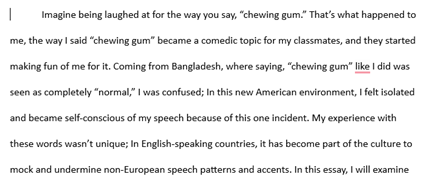
I learned that academic writing allows for personal voice when supported by evidence; specifically, I developed the ability to utilize research to validate my own lived experiences with linguistic prejudice. Before this course, I felt that writing something such as the synthesis essay meant supporting a stance and just mindlessly spewing out sources that agree with that stance. I believed my own opinion and voice were not to be used in that text, and that only the sources mattered. However, while writing the synthesis essay, I flipped this approach by starting with my own experience of linguistic prejudice. I opened the essay with “Imagine being laughed at for the way you pronounce something as simple as ‘chewing gum’… Coming from Bangladesh, where saying ‘chewing gum’ like I did was seen as completely ‘normal,’ I felt confused and isolated in this new American environment.” By leading with this personal experience, I established my voice instead of letting that voice drift away, then found a source that didn’t just explain the topic but validated my specific experience. Safwat Saleem faced a similar experience in his TED Talk, noting he stopped using his voice due to negative feedback. Integrating Saleem’s quote was a turning point. I used his quote to prove that the isolation I felt was part of a larger systematic problem. This assignment taught me that academic writing doesn’t require me to silence my own voice; Instead, it empowers me to use research as a tool to boost and support my thinking.
I developed a critical awareness of the “Rhetorical Situations:” audience and purpose, which transformed my writing and reading process from simple storytelling to making active and strategic choices to connect to my readers. Before understanding these concepts of Rhetorical situations, I would write and read for assignments just to have them finished, writing only because “the teacher told me to.” But now, in my Cover Letter for the Language and Literacy Narrative, I thoroughly analyze these factors to shape my essay. In my cover letter, I wrote, “My audience for the language and literacy narrative is you, my professor; I also considered my classmates as a secondary audience… I chose my language and literacy narrative to be written in such a way that it feels personal and heartfelt.” I also said, “I knew the purpose wasn’t just to tell a story from my past but to use that story and connect it to something bigger… This sense of purpose heavily impacted the structure of my narrative, and it’s the reason why I concluded the narrative with a completely different tone in the last paragraph.” This proves I considered rhetorical situations and didn’t just do the assignment. By using audience and purpose to craft my essay, I demonstrated that I can effectively control rhetorical situations to ensure my message is received properly, rather than hoping the reader understands me.
I learned that translating a text from a written format to something that includes visual aids to explain that text gives a whole new perspective and audience to that text. This realization came during the Translation 1 assignment, where I converted my LLN into a Google Slideshow. This process taught me that as the medium changes, you must adjust how you communicate what you are feeling and thinking to meet the audience. For example, in my LLN, I described the reading group environment in detail to convey feelings of safety and comfort. When converting this to Google Slides, I couldn’t just put a text box. Instead, I had to find a series of images that captured what the room was like exactly and put that in one slide, along with the text describing the room. This visual translation demonstrated the effectiveness of digital technologies and was illustrated by this. The visual slide showed the cozy sensation to the audience in a split second, while the text told the reader the room was cozy. This made me realize that images are regularly more powerful than words for a digital audience, which gave me a whole new level of communication skills.

Before taking this course, I had not given much thought to how oppressive linguistic standards could be, but now I understand. The way in which I learned English and the way in which it is taught here in America are different. So, after I came to America and had an unpleasant experience with the way I said certain words, I internalized the idea that there was a right way of speaking English and that my way, which I had grown up with, was wrong. However, through the readings we did in English 110 and my own writing in the Synthesis Essay, my perspective changed entirely. At the end of my Synthesis essay, I talk about how my pronunciation back then “was never the problem; the problem was a culture that refused to respect it.” This learning experience was the most significant for me. I picked up on how attitudes toward linguistic standards oppress language users by giving them the impression that their opinions are invalid. I have since then stopped blaming myself for not sounding “American” enough and started questioning the culture that made me feel so in the first place.

This entry is licensed under a Creative Commons Attribution-NonCommercial-ShareAlike 4.0 International license.

