Self-Assessment
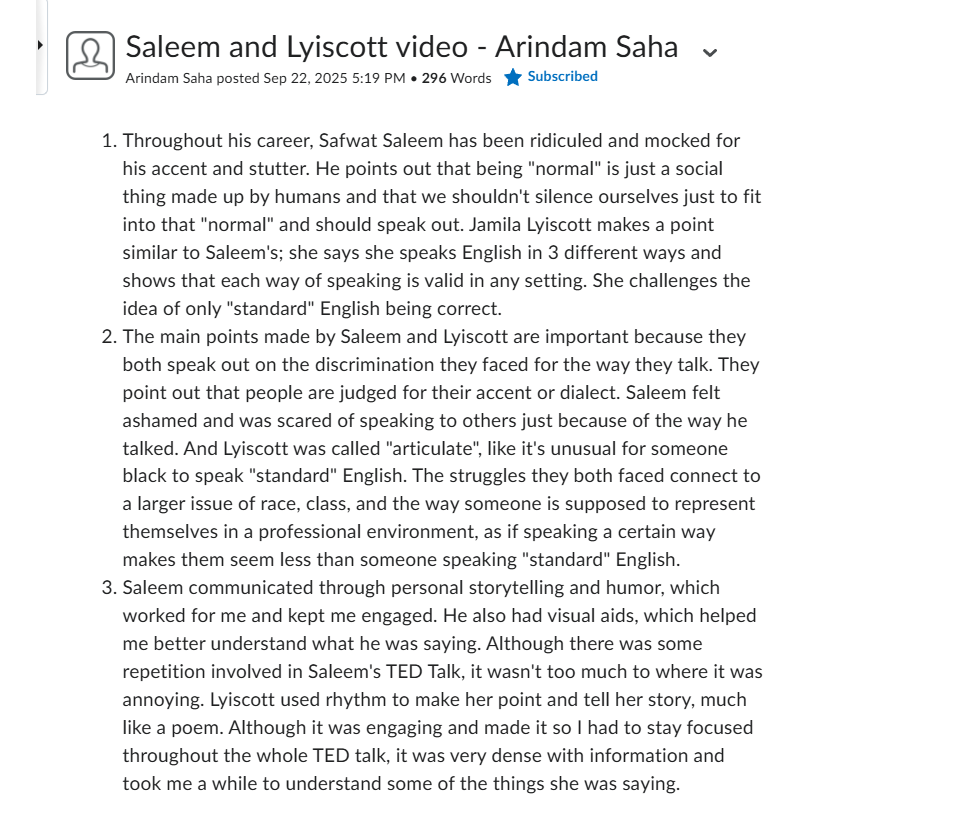
Learning objective #1: Examine how attitudes towards linguistic standards empower and oppress language users.
My Paraphrase: How opinions towards the use of standard English belittle those who don’t speak standard English or give power to those who do speak standard English.
Evidence of learning:
For the Engl 110 course, we had an online discussion forum where we answered 3 questions relating to linguistic standards based on 2 different videos.
Here is my response
My score 0-5: 5
******
Learning objective #2: Explore and analyze, in writing and reading, a variety of genres and rhetorical situations.
My paraphrase: Examine different pieces of writing through many genres and the different rhetorics in them.
Evidence of learning:
Throughout this course, we read multiple different pieces of writing and completed a rhetorical worksheet for them. In my rhetorical worksheet for June Jordan’s essay “Nobody Mean More to Me Than You,” I analyzed all the rhetorical terms.
My score 0-5: 3
******
Learning objective #3: Develop strategies for reading, drafting, collaborating, revising, and editing.
My paraphrase: Learning and applying effective techniques to write a proper essay through different stages, such as drafting and peer review.
Evidence of learning:
For the LLN and Synthesis essay, we did peer review and recieved instructor feedback for them. So on my portfolio website, I have my first and final drafts of both essays.
My score 0-5: 3
******
Learning objective #4: Recognize and practice key rhetorical terms and strategies when engaged in writing situations.
My paraphrase: Developing the skill to recognize rhetorical terms in readings and use rhetoric in writing.
Evidence of learning:
In my cover letter for my Language and Literacy Essay, I consider factors like who my audience is and the purpose of my essay to write a proper essay that includes rhetoric.
My score 0-5: 3
******
Learning objective #5: Understand and use print and digital technologies to address a range of audiences.
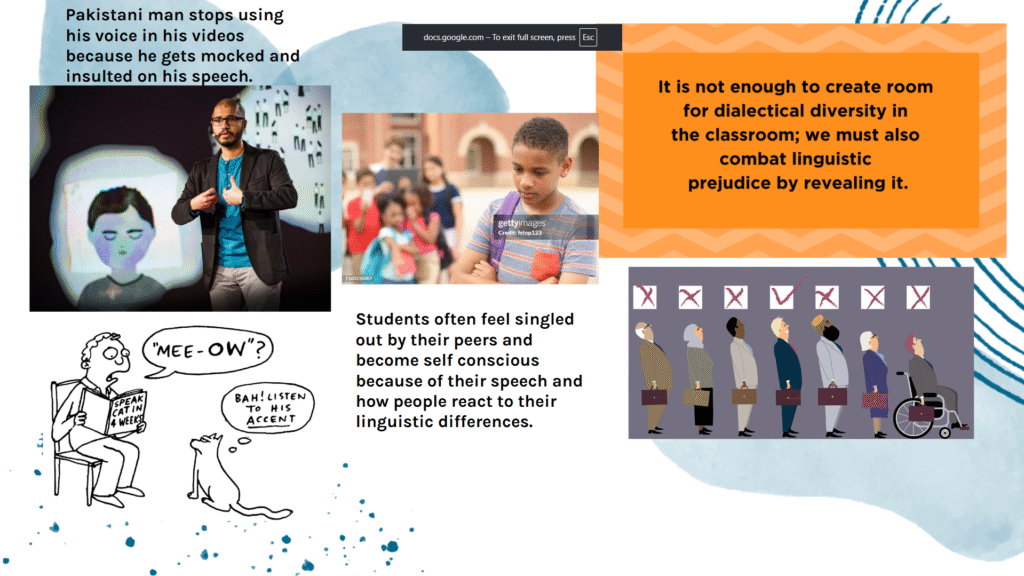
My paraphrase: Turning writing into a different form of visual media, like Google Slides, video, and more, that supplies the same information to a larger range of audiences.
Evidence of learning:
I transformed my synthesis essay into a Google Slides for my Translation 2 assignment.
My score 0-5: 4
******
Learning objective #6: Locate research sources (including academic journal articles, magazine and newspaper articles) in the library’s databases or archives and on the Internet and evaluate them for credibility, accuracy, timeliness, and bias.
My paraphrase: Researching ability using different resources provided and brainstorming keywords for researching. Verifying credibility.
Evidence of learning:
I used websites like Google Scholar and the CCNY library website to locate my sources. I searched up key terms like “linguistic prejudice,” “accent bias,” “South Asian,” “discrimination,” and more to first get a hold of sources that might be what I need and then read the abstracts to pick out articles that wouldn’t relate to my essay. For credibility, I checked if the article was peer-reviewed or not; if not, I would do some basic research on the authors to verify if that article would be credible.
My score 0-5: 3
******
Learning objective #7: Compose texts that integrate a stance with appropriate sources, using strategies such as summary, analysis, synthesis, and argumentation.
My paraphrase: Creating a piece of writing that contains my opinion and voice with sources that support my opinion.
Evidence of learning:
In my Synthesis essay, I was able to write something that authentically contains my voice with supporting sources and analyses of those sources.
My score 0-5: 4
******
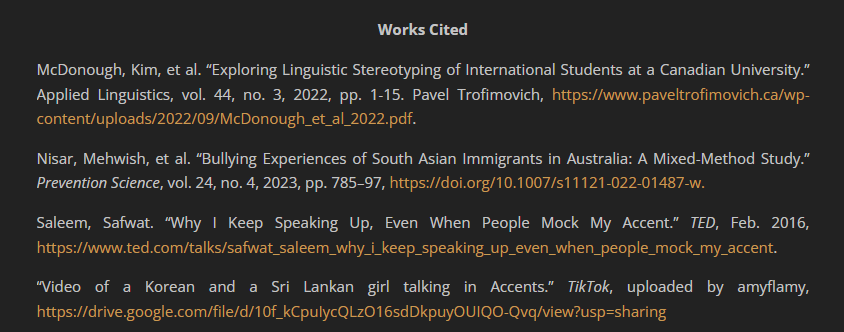
Learning objective #8: Practice systematic application of citation conventions.
My paraphrase: Using proper MLA formatting to give credit to writers.
Evidence of learning:
My Synthesis essay contains a works cited page, which is done in MLA format to give credit to the sources I used.
My score 0-5: 3

This entry is licensed under a Creative Commons Attribution-NonCommercial-ShareAlike 4.0 International license.

